Chapter 01 · The connected map
One concept can teach several subjects at the same time.
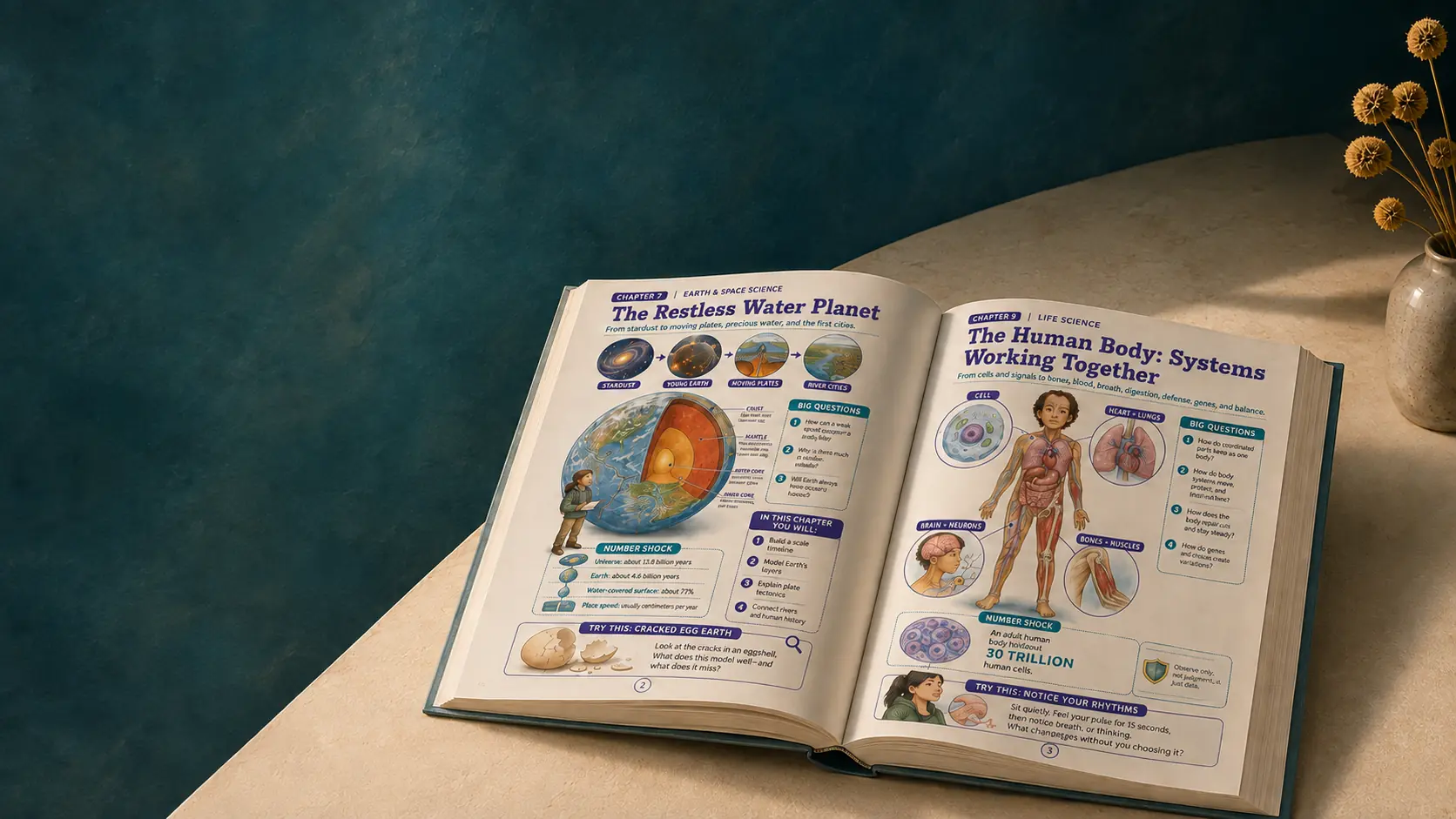
School often divides one idea into separate periods before anyone shows the learner how the explanations fit together. Avid Thinking begins with the shared concept, then teaches the biology, chemistry, physics, mathematics, language, history, and practical applications around it. Students spend less time relearning the same vocabulary in isolation and more time building one durable mental model.
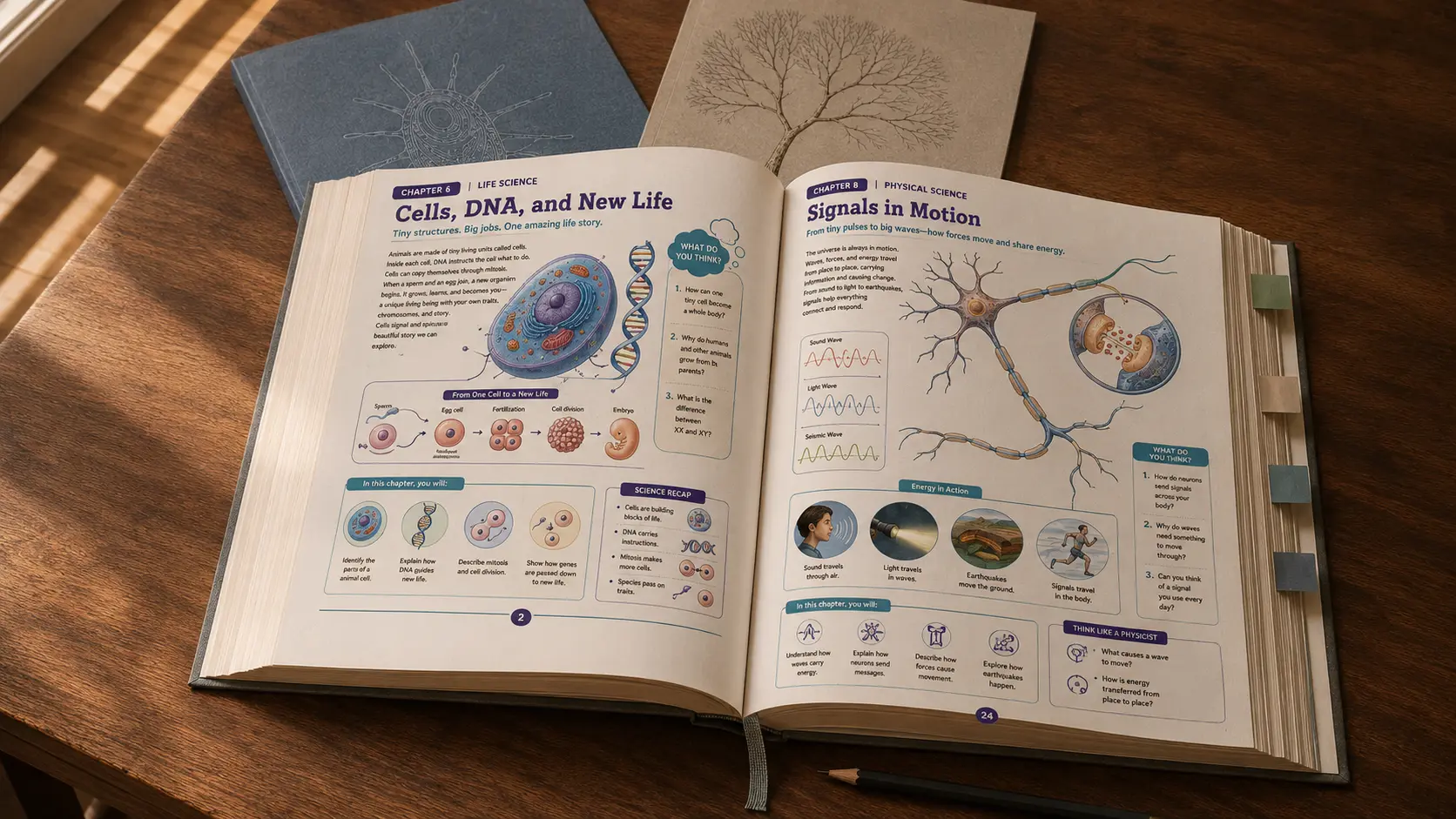
Consider a neuron. Biology identifies the cell body, dendrites, axon, membrane, and synapse. Chemistry explains ion gradients, receptors, neurotransmitters, and the reactions that let signals cross a membrane. Physics examines voltage, charge, resistance, diffusion, thresholds, and the forces involved in whether a signal propagates. Psychology and neuroscience connect those cells to sensation, learning, memory, behavior, and disease.
Mathematics lets the student graph membrane potential over time, measure rates of change, compare thresholds, and reason from evidence. History shows how microscopy, staining, competing theories, and new instruments changed what scientists believed about the nervous system. Human geography and sociology ask who receives diagnosis, treatment, research attention, and access to new technology.
English language and literature enter through precise explanation, argument, metaphor, and the way people write about mind and identity. Greek and Latin roots turn technical words into clues instead of obstacles. Medicine extends the lesson into diagnosis and pharmacology. Engineering extends it into sensors, neural interfaces, prosthetics, and computation. One carefully designed sequence therefore teaches several courses at once while making each subject easier to remember.
While teaching himself much of 11th and 12th grade, Chris used this connected approach for independent AP work and earned AP Scholar recognition. Avid Thinking turns that lived method into structured lessons, printed materials, practice, and assessment that other students can use deliberately.
“The more you learn, the easier it becomes to learn more.” — Chris Rios
Chapter 02 · Language inside the subject
Greek and Latin roots turn vocabulary into a set of clues.
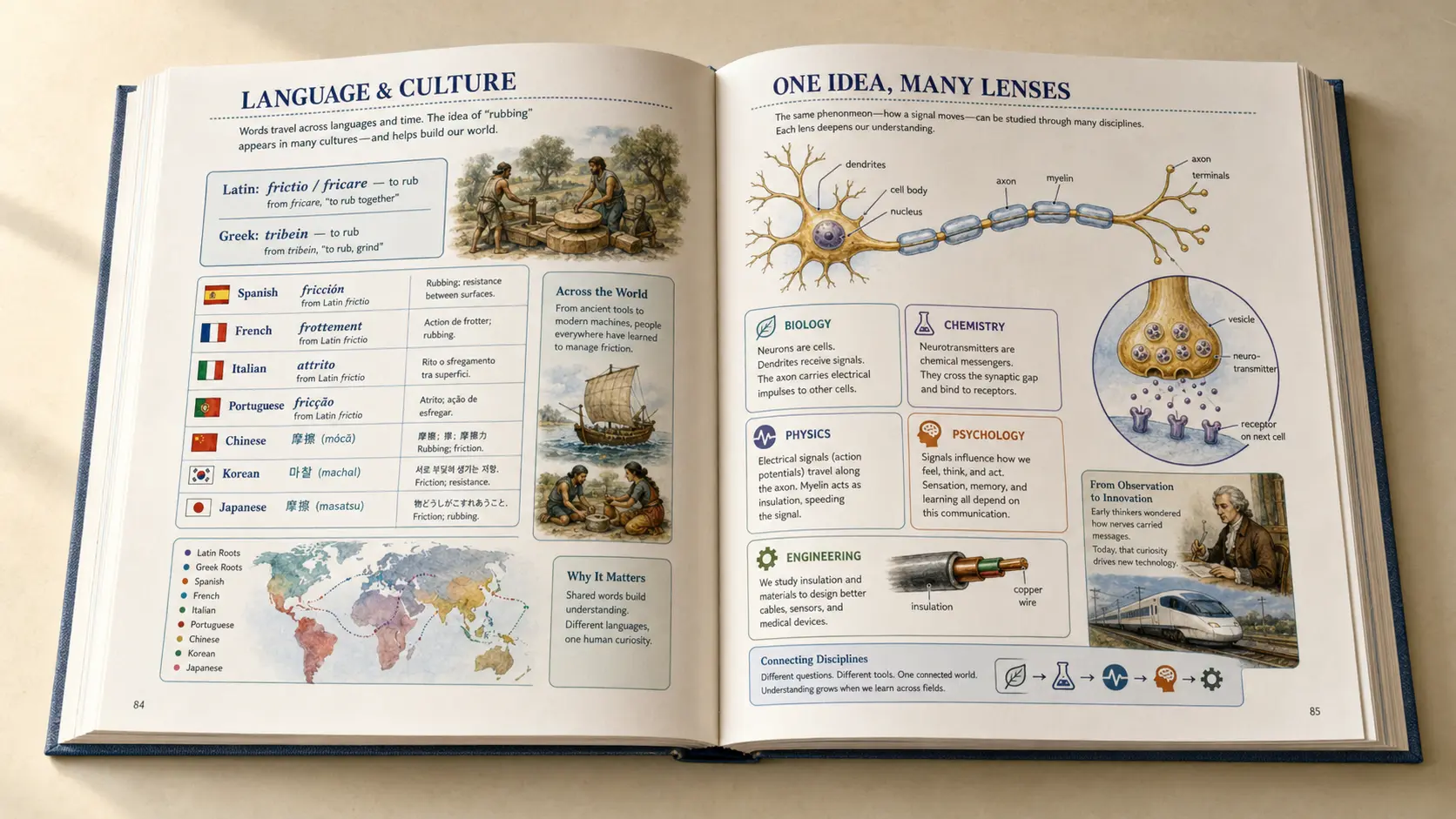
Long academic words can make a capable student feel locked outside a subject. We teach the keys. Bio points toward life. Photo points toward light. Geo points toward Earth. Therm points toward heat. Prefixes, suffixes, cognates, and word families let a learner predict meaning instead of waiting to be rescued by a glossary.
This language work belongs in science, mathematics, history, and computer science because every field builds compressed vocabulary. When students learn to open those words, reading becomes faster, class discussion becomes less threatening, and new terms attach to a structure they already own.
The method also uses more than one doorway: visual models, spoken explanation, handwriting, typed work, experiments, movement, carefully chosen media, and American Sign Language connections when useful. Access supports do not lower the intellectual ceiling. They remove the unnecessary wall between a learner and the work.
Chapter 03 · The page becomes a workspace
Printed books slow the lesson down just enough to let the idea stay.
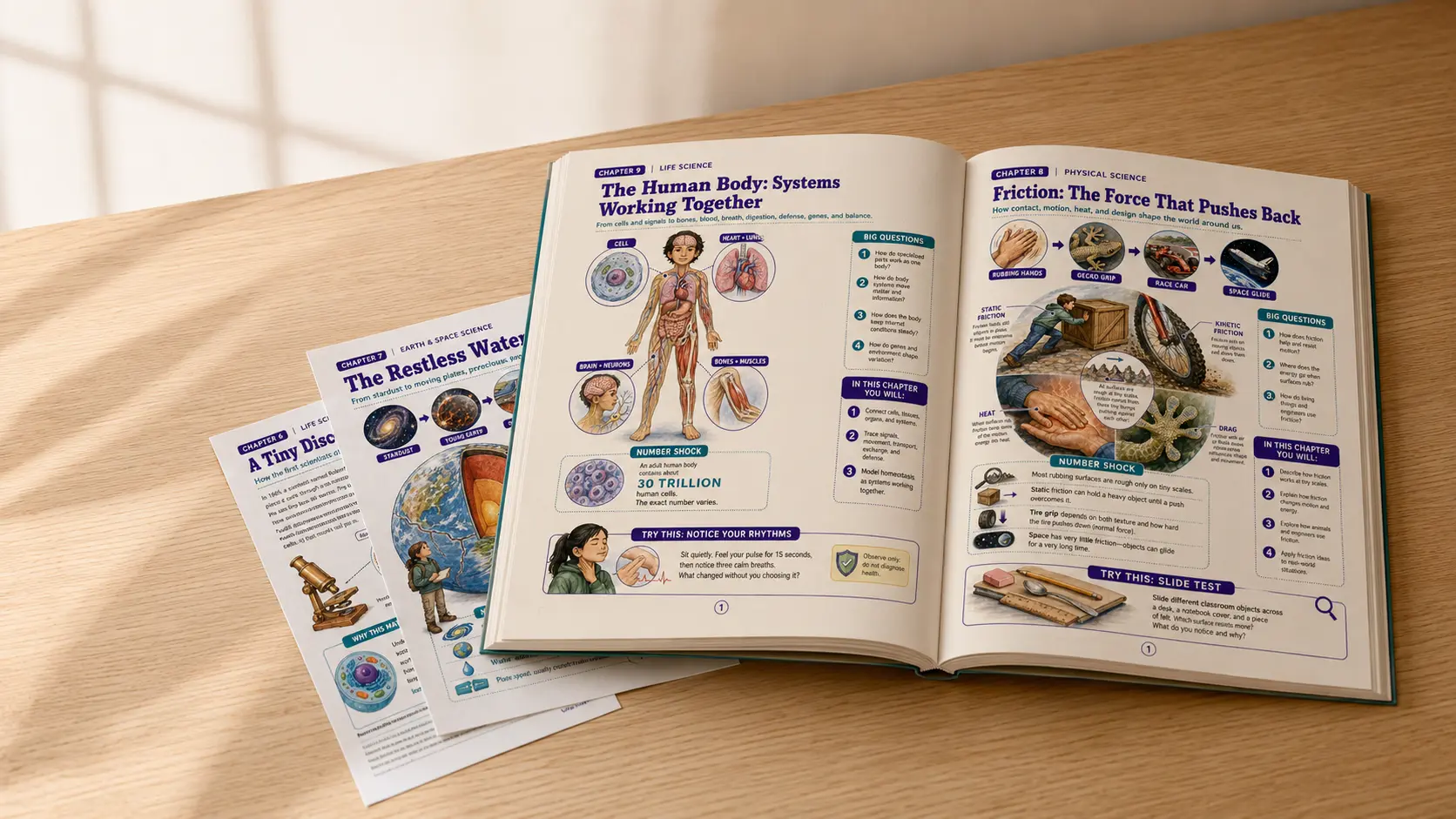
Technology is useful when it lets a student simulate, calculate, hear, magnify, code, or receive access support. It becomes less useful when the interface itself is the loudest thing in the room. Avid Thinking therefore treats the printed book as part of the method—not nostalgia, but cognitive equipment.
A page can hold a diagram, root words, an equation, a worked example, and room for an objection at the same time. Students can point to two distant details and ask why they disagree. They can leave a hard spread open on the desk. That physical continuity matters for children who have already spent a school day moving through tabs.
Chapter 04 · Progress without theater
We look for a changed performance, not a prettier promise.
For a struggling student, the first victory may be naming the hidden gap, completing work without avoidance, or explaining a process that previously felt random. Chris has reported individual cases with gains as large as 2.5 grade points. Avid Thinking is formalizing baseline and cohort tracking before describing that number as a verified average.
Gifted and highly talented students use the same connected method for harder problems, independent research, AP work, invention, and portfolio-quality projects. The goal is not more worksheets. It is a wider field of meaningful difficulty.
Work products, explanations, revisions, assessments, and capstone projects make progress inspectable. Parents should know what changed, what did not, and what the next move is.
No curriculum can guarantee a grade, score, admission result, or identical outcome. The promise is a serious method, direct feedback, and a record honest enough to improve the next decision.